FX protection built into payments and invoicing
Let PSPs offer SMEs certainty on future cross-border payments, invoices and payroll.
→ Also available for AI agents — connect via MCPProtection without disruption
CurrencyGuard sits between invoice or payment creation and FX conversion. You keep pricing, conversion and settlement. Your client keeps the upside.
Downside covered
If the rate moves against your client, they convert at the Guard rate. Their cost cannot exceed it.
Upside kept
If the rate moves their way, they pay the market rate and keep the saving. A Guard is not a forward: nobody is locked in.
One fee, paid once
A Guard fee at the start. No credit line, no collateral, no margin calls, nothing on your balance sheet.
For the PSP
Why you can offer it at scale
Forwards need margin from the client and capital from you. A Guard needs neither, which is why it can be offered to every SME on your book rather than the few who pass a credit check.
| Feature | The Guard | Forward Contract | No protection |
|---|---|---|---|
| Collateral / Margin Required | ✓None | ✗Initial margin + MTM | ✓None |
| Balance Sheet Impact | ✓None | ✗Consumes PSP capital (hedging) | ✓None (but FX impacts P&L) |
| Client keeps the upside | ✓Yes | ✗No, the rate is fixed | ✓Yes, and all of the downside |
| Who carries the market risk | CurrencyGuard, neutralised back to back for every Guard sold | You, or your bank, with capital against it | The SME |
Forward contracts require margin in most cases from both the client and the PSP. To hedge the exposure, the PSP must commit its own capital — limiting how easily forwards can be offered at scale.
Not a regulated derivative
The Guard is structured to fall within the ‘Means of Payment’ exclusion under UK MiFID regulation when used for identifiable goods or services. It is not regulated as a derivative when used in this way.
You set the margin
Every quote is the protection price plus your margin. The client relationship, the conversion and the settlement stay with you.
Live in days, not weeks
Integrate through the API, or start selling from day one with the white-label sales platform and no build at all.
What your customer sees
Both sides of a Guard, live on this site
A seller quoting a client abroad, a payer with a bill in another currency, and an employer paying people overseas every month. The first two run live on this site. No signup for any of them.
2:03, narrated.
The seller
Quote in their currency. Keep your margin.
A client abroad wants a price in their own currency. The agent checks in your accounts when they usually pay, gets a Guard price from your payment provider and tells you what to quote. You know your minimum in your own currency before you reply, and if they negotiate you see straight away what it costs you.
Have this conversation with your numbers →The agent in the film is our connector. Open it in Claude, or on this site, and ask it about your next invoice. Read why a bank could never build this →
Invoice in pounds
The risk moves to your buyer.
Buyers prefer their own currency
Pad the price
Add a margin and hope.
Costs you the deal, or the margin
Book a forward
Separately, for the full amount.
Deposit, margin calls, credit line
The payer
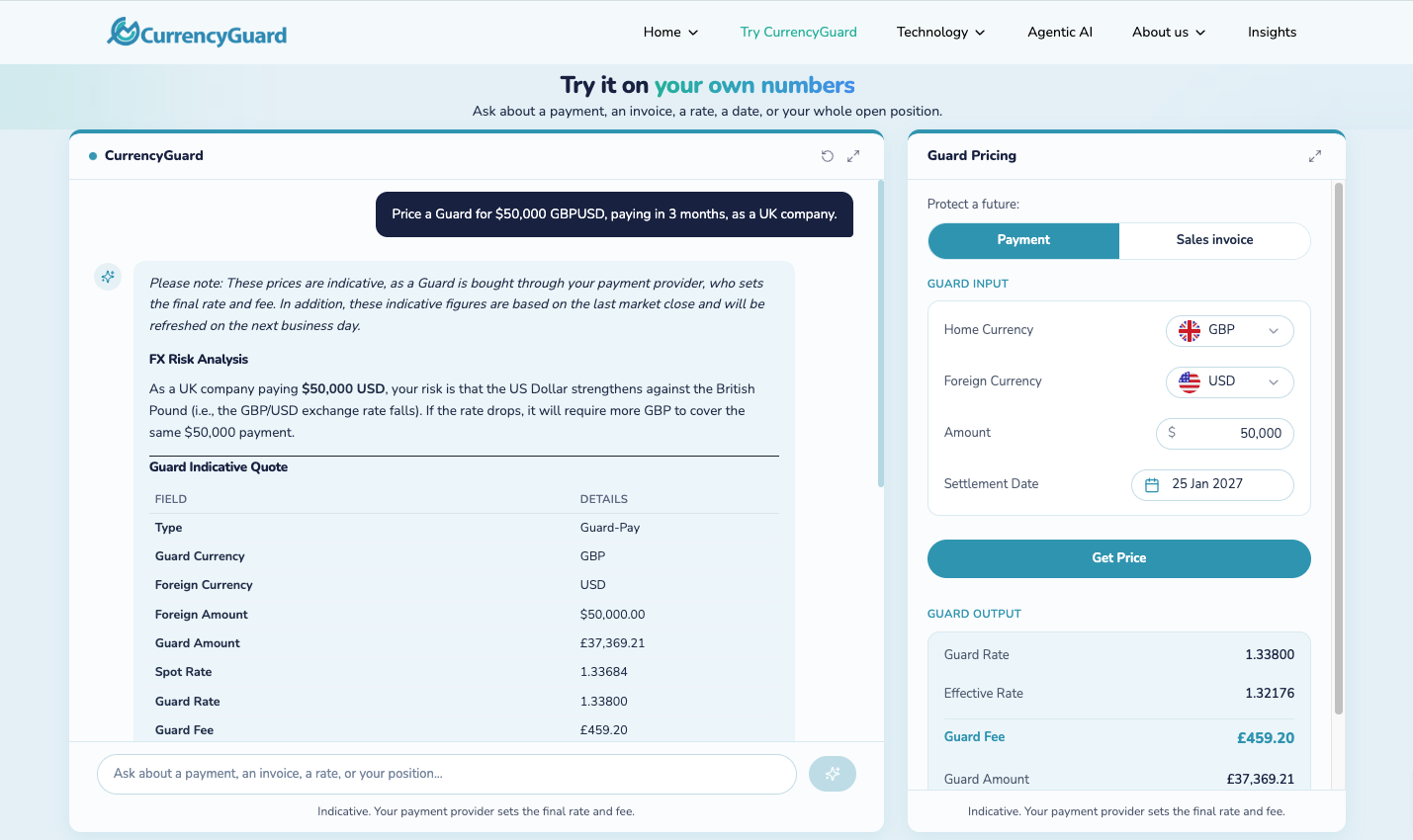
Ask for a price in one sentence.
“Price a Guard for $50,000, paying in three months.” Back comes an indicative Guard: the rate, the fee, the maximum cost, and the settlement window. The pricing panel fills itself from the conversation.
Try CurrencyGuard on real numbers →The quote is what your customer would see inside your product, under your brand. You set the final rate and fee.
The employer
Protect a whole payroll run, one pay date at a time.
An employer pays staff and contractors in five currencies on the 25th. One Guard per currency, per pay date: the maximum funding for the run is known the day it is drafted, and whatever the rate gives back on the day is theirs. Payroll repeats, so this is a Guard a month for every client on the book, not a one-off.
Before the Guard
The treasurer nobody hired
of small businesses protect themselves against currency moves. The tools were built for companies with a treasury department.
See what you really owe in foreign currency.
Connect Xero or QuickBooks, or drop in a CSV or Excel export of open invoices and bills. CurrencyGuard nets receipts against bills, shows what is really open in each currency, and for each item what doing nothing, a forward or a Guard would have meant. Free for the SME. Nothing is kept after the page closes.
Nothing is sold on that page. When an SME wants the Guard, it is bought through its payment provider: you. Think of it as clients arriving already knowing their exposure.
Load
Xero, QuickBooks, or a CSV or Excel file. Open items only, read as they are.
Net
Receipts fund bills first. What is left is the real exposure, item by item, with its due date.
Compare
Do nothing, forward or Guard, side by side on the SME's own numbers. An illustration of outcomes, not advice.
Talk to us about embedding CurrencyGuard
Tell us what you process and for whom. We will come back with what a Guard would look like inside your flow.
Questions on accounting, regulation or settlement are answered in the FAQ.
Built by a team from Barclays FX, Goldman Sachs and Currencycloud, with 100+ years in institutional FX, payments and trading technology.