When AI Commits to a Payment, Who Manages the FX Risk?
Agentic Cross-Border Payments Need a Protection Layer
Over the next few years, many SMEs will not "search for suppliers" in the traditional sense.
Instead, they will instruct a procurement assistant:
"Find me a US supplier for component X, delivery within 90 days, unit cost below $12, minimum quality rating 4.5, landed margin of at least 15%."
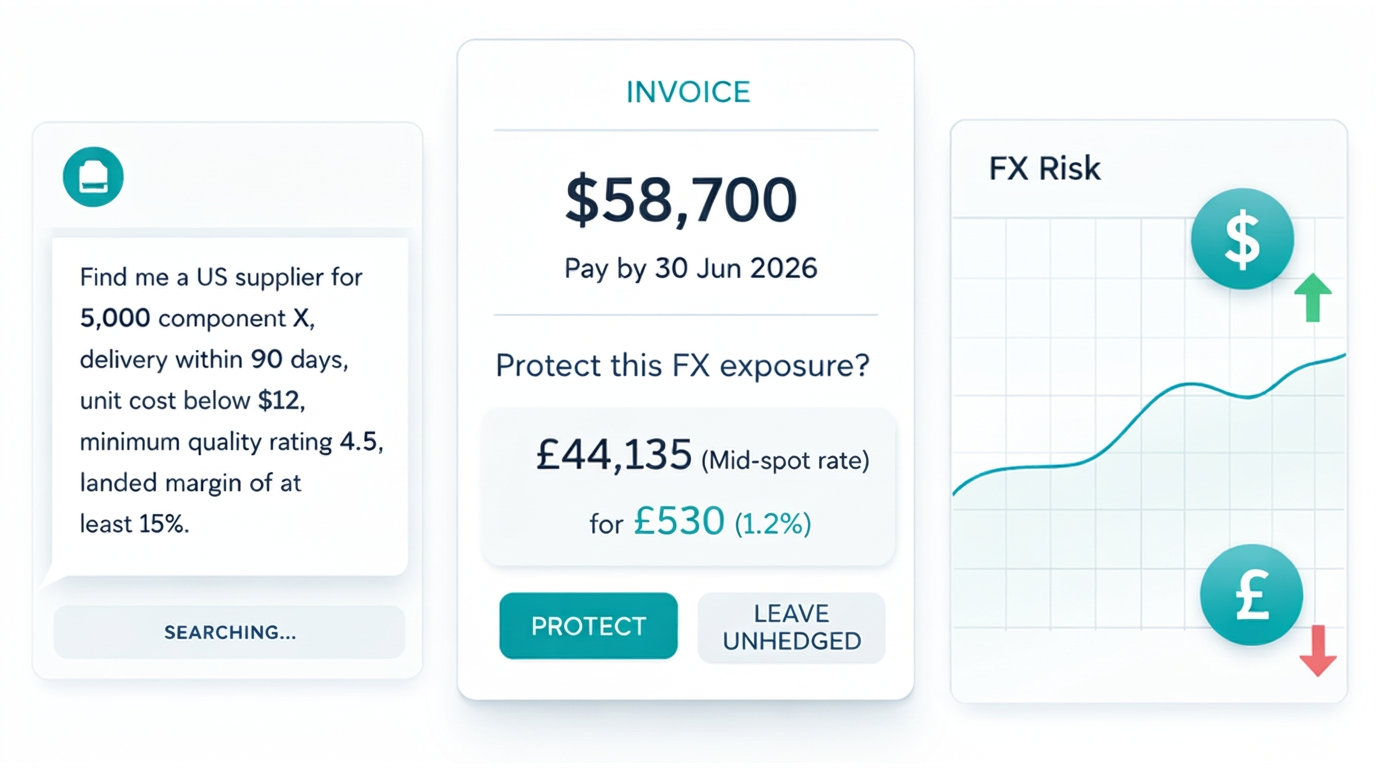
The system will screen approved vendors, compare lead times, estimate freight and duty, draft a purchase order and present a structured recommendation.
The finance director still approves the decision.
This is what people mean by agentic commerce: not artificial intelligence replacing businesses, but structured systems executing defined tasks within preset financial and operational rules.
In cross-border trade, however, one consequence remains unchanged.
The moment a purchase order is approved, a foreign currency commitment exists.
And that commitment carries risk.
When Automation Meets FX Exposure
Consider a UK SME importing $250,000 of components from a US manufacturer.
Payment terms are typical:
- 20% ($50,000) on order
- 80% ($200,000) payable in 90 days
The initial payment is straightforward.
The $200,000 due in three months is not.
If GBPUSD moves 4–6% against the importer over that period, the margin on the shipment can be materially reduced. For many SMEs operating on 12–18% gross margins, that movement is not theoretical — it is commercially significant.
Automation accelerates procurement.
It does not remove currency risk.
The Same Shift on the Selling Side
The dynamic is similar for SMEs selling abroad.
A UK exporter may increasingly rely on AI-assisted quoting tools that evaluate whether offering EUR instead of GBP would increase conversion probability with a European client.
Offering local currency pricing can improve win rates.
But it also transfers FX risk back to the seller.
If settlement occurs in three or four months, a material currency move can erode the expected margin on the deal.
In an automated quoting environment, currency flexibility must be paired with structured protection.
Otherwise, faster deal execution simply creates faster exposure.
Why Traditional Structures Do Not Fit Automated Workflows
Traditional FX risk management was designed around manual treasury processes.
In practice, it relies either on unsecured credit lines — which are rare for SMEs — or on collateralised structures requiring margin monitoring and ongoing exposure limits.
That structure can work for larger corporates.
It is less suited to environments where banks and PSPs have limited appetite to extend unsecured FX hedging credit to SMEs, particularly when exposures are small and operationally intensive.
It is even less suited to automated procurement and invoicing workflows.
Agent-assisted systems require protection that is:
- Linked to a defined invoice or payable
- Bounded in downside
- Deterministic in cost
- Free from open-ended obligations
- Programmatically accessible
If cross-border trade becomes increasingly assisted by software, the protection layer must be structurally compatible with that environment.
Built for Embedded, Programmable Protection
CurrencyGuard was designed around a simple principle: SMEs should be able to protect a scheduled foreign currency payable or receivable without relying on credit facilities, collateral or margin management.
Each Guard is linked to a specific invoice or future payment.
The protection cost is defined upfront (even if the payment can be delayed). There are no margin calls and no ongoing funding requirements.
That structure was built for embedded distribution through PSPs.
It is also naturally aligned with agent-assisted cross-border workflows.
An AI-supported system can:
- Identify a supplier or customer
- Structure payment terms
- Model FX exposure for a defined settlement date
- Request Guard pricing
- Compare protected and unprotected outcomes
- Present a consolidated decision for approval
- Monitor for changes in commercial parameters (delivery delays, partial shipments, contract amendments or counterparty issues) and adjust the protection structure accordingly
The commercial logic and the protection logic can operate within the same workflow.
Already Prepared for Agent-Driven Environments
Much of the discussion around agentic commerce focuses on checkout, payment execution and stablecoin rails.
Stablecoins may change how cross-border payments settle. They may make execution faster, cheaper and fully programmatic.
But they do not eliminate FX exposure.
If a business commits today to pay or receive foreign currency in three months, the economic risk exists regardless of whether settlement ultimately runs through a bank transfer, card network or stablecoin wallet.
As settlement becomes more automated, protection must be equally programmable.
Cross-border trade therefore requires an additional layer: risk management between commitment and settlement.
CurrencyGuard sits above the payment rail. It protects the economic outcome while allowing the underlying execution mechanism to evolve.
To support that environment, CurrencyGuard has already exposed core functionality via MCP-compatible integration. MCP (Model Context Protocol) is an emerging standard that allows AI agents to securely call external tools and APIs in a structured way — giving agents controlled access to financial infrastructure. The protocol landscape is still forming, and multiple standards are likely to coexist.
Through MCP-compatible integration, CurrencyGuard enables:
- Live Guard (protection) pricing for payables and receivables
- Guard-Invoice for sellers who want to offer buyer currency flexibility without taking currency risk
- Historical stress modelling
- Structured explanation of outcomes
This allows AI-assisted systems to incorporate FX protection directly into procurement and invoicing workflows.
Execution remains gated pending onboarding and approval.
The pricing, modelling and integration architecture is already in place.
As workflows evolve — whether on traditional rails or stablecoin-based settlement — the risk layer does not need to be reinvented.
It is already architected for that world.